All about air conditions, temperature, humidity, air conditioners, heaters, HVAC, ac, AC, pressure, air quality, filtration, allergens, mold, rust, fungi, refrigerants, r22, r410A, dupont, Isceon, M099, r438a, and more.
All right today I wanted to go over the five most common problems with HVAC air conditioners.
Say you go to turn you’re air conditioner or heater on on cool or heat and auto and you lower your temperature down and let’s say nothing happens. The unit doesn’t turn on the blower doesn’t turn on at all first thing you want to check is the breakers.
It could be a tripped breaker. You often have a breaker for the condenser and then a breaker for the fan itself this one is right here for the fan. So make sure your breakers are not tripped. Sometimes if they’re tripped they will trip halfway and when you reset it you need to turn the breaker all the way off and then turn the breaker all the way back on.
Next thing to check is the door switch often there is a service door switch on the air conditioner heater unit it’s usually located right here (top left side of the air handler) what you want to do is push on this left side to see if that will engage that switch. So if you got it on heat or cool and auto already. A lot of times that will be the problem.
Sometimes you might need to add a screw. Like this one a screws been added to make sure that it is held in place. Or you can tape the door shut. If you do add a screw you want to make sure that that screw isn’t going to be penetrating into anything. Like any tubing or anything like that such as any refrigerant tubing behind it you want to make sure you pick a place that is good and you don’t want a screw that is too long you don’t want it to poke into anything that it’s not supposed to.
Ok the number three most common problem with air conditioners. So one we had a breaker tripped, two, the service door switch.
The third most often cause of an air conditioner not working is inside here if this hatch comes open. Sometimes let’s say it wasn’t secured properly it’s got this like a mailbox latch that latches the door into place and if that came open and this hatch falls open a lot of times what happens is your evaporator coil will freeze up into a block of ice.
So while you are there you got your filter and your filter make sure you have good air flow that a lot of times what will happen is that will turn to a block of ice and you won’t even be able to pull the air filter off of it.
What you want to do is come over here to your thermostat and just turn the cool side off and just turn just the house fan on so turn the fan on on and put the switch here on off that way you can defrost the air conditioner and you also kind of want to watch it to make sure your condensation line doesn’t overflow.
It could get built up with too much water from the ice melting. So something to keep an eye on there but keeping the fan on will help melt the ice faster and dry everything out.
You know get back to normal. It takes a little while and than you’ll be able to put it to cool and auto again and you’ll close this door and again if you need to you will add a screw or you can add some tape to make sure that its held in place and doesn’t come open on you again.
Number four most common problem with HVAC heaters and air conditioners is a fan motor that won’t start. Often you can just replace the fan start capacitor.
I have a video showing you how to do that, “First Thing To Try” “Before” you just run out and replace the “Motor” is to try “Replacing” the fan start capacitor and it’s not truly a start cap it is actually a run cap but replacing that capacitor that capacitor helps get the fan started going and gives it that initial kick to start. Without that it can’t start it will just sit there and hum and sometimes you can even push start it with a pen or something. You know “very carefully”.
And the fifth most common cause of losing your heating or air conditioning is a faulty thermostat so you can click on over to my video about how to troubleshoot a faulty thermostat.
Anyway those are the five most common problems with heating and air conditioning that you will come across that will give you a no cool or heat call, and I have videos on all of those so you can check them out. I will try to put the links here or right on this videos so you can click over to watch those.
And thats the five most common problems with the indoor side of HVAC heating and air conditioning.
Alright, got a pretty old unit. Well got a unit low on freon.
You can see one of these energy devices that turns off the AC on the front of the unit some of the electrical companies out here in California hook these up so they can turn the unit off at peak hours and than they pass on a little bit of energy savings to you, give you a cheaper rate on your
air conditioner.
This one is actually mounted on the service door. Anyway I am gonna take this door off. And I have got a unit that is low on freon.
It is not cooling so. At least not cooling very good anyway.
Get into this and than I’ll go downstairs
and turn the unit on. Get the door here. Put this off to the side. There we go. Let’s see what is going on here.
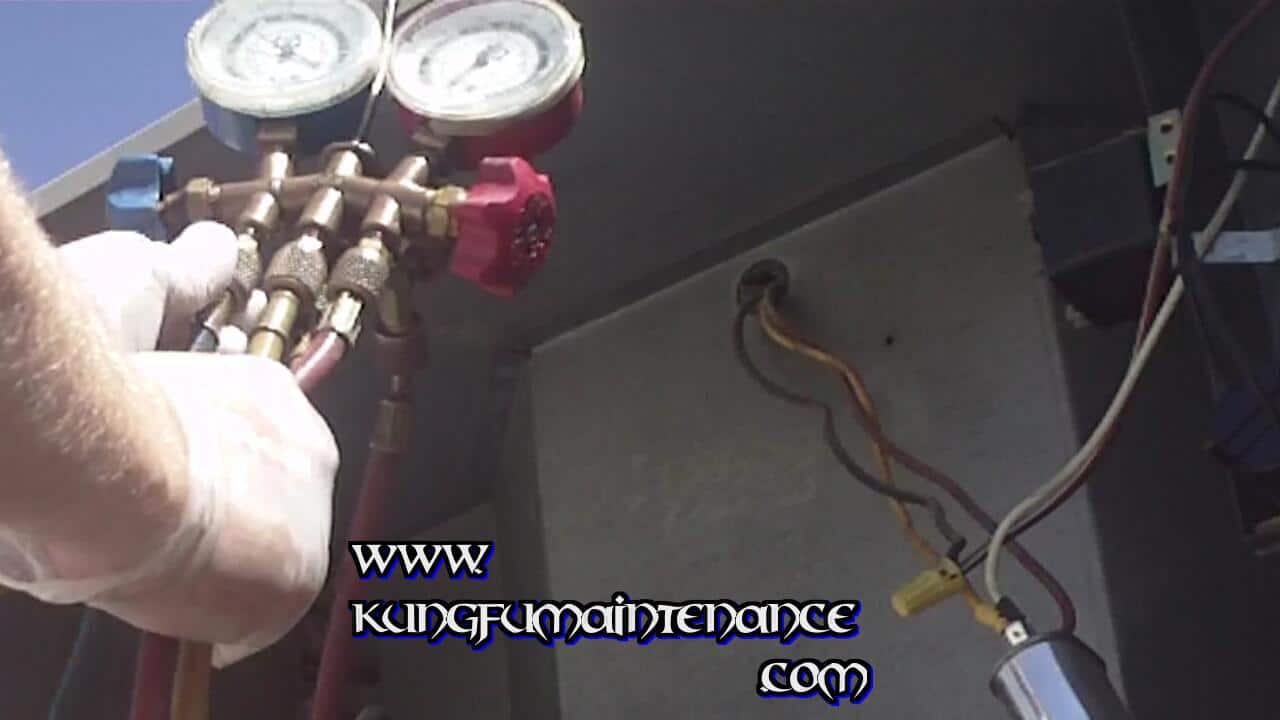
I am going to go ahead and get my gauges set up here.
And than charge this up here.
My gauges are not in the best shape especially the high side so I am just going to be charging it up through the low side today. It’s time for me to order some new gauges.
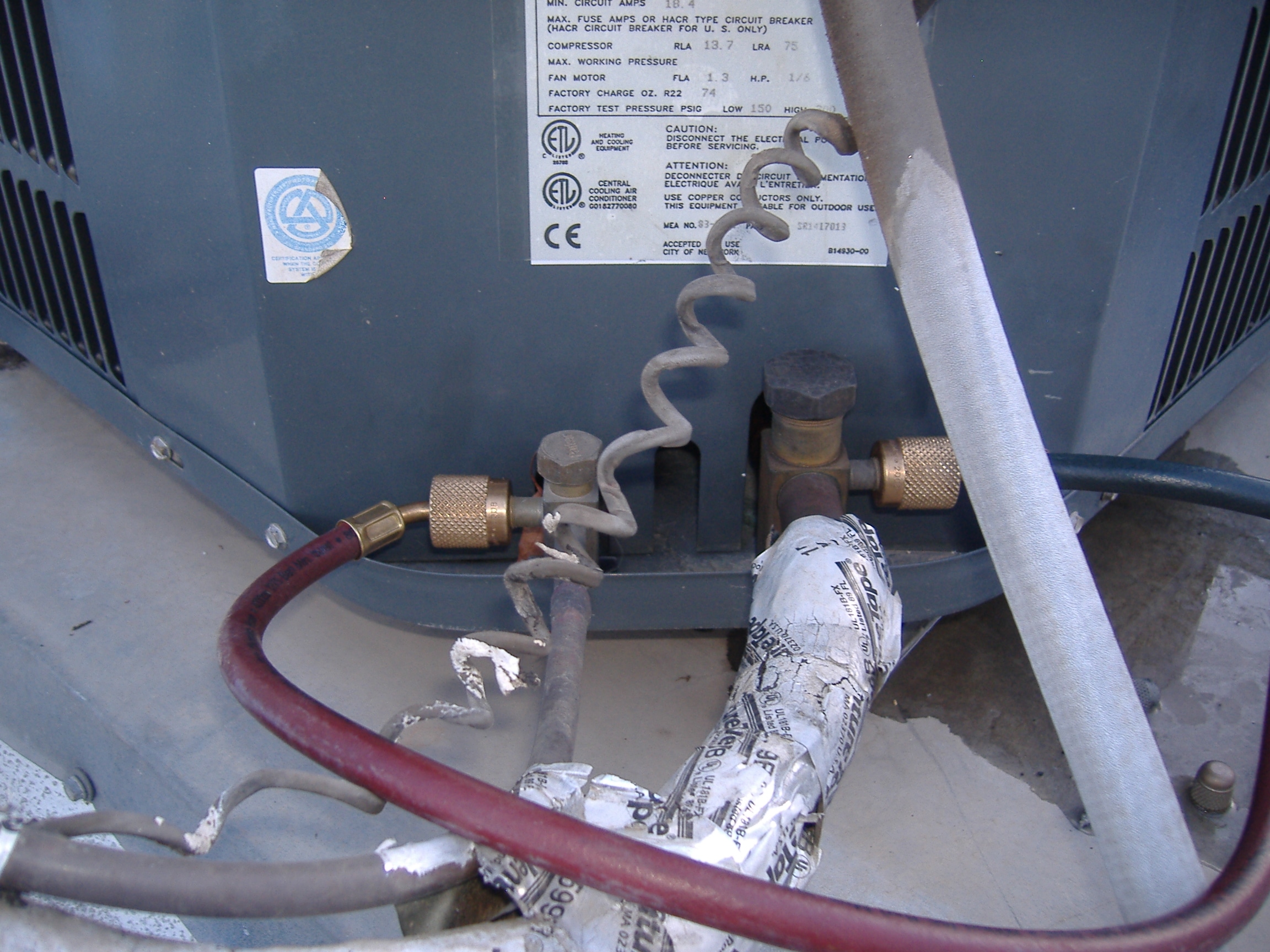
Right here is our service line hook up. And what you want to do is make sure the valve is off up top here on the low side and the high side. Ok
Now remove my schrader valve cap and listen for any kind of hissing.
To indicate if there is a leak. And it seems Ok.
And it’s got these quick connect fittings. You always want to use these quick connect fittings. You really want to wear gloves to but since i’m just going through the high side. Not so bad I mean I’m just going through the low side. It is not so bad on the low side.
A little bit worse on the high side. Ok now that the line is hooked up there we want to make sure that we purge any airfrom the lines.
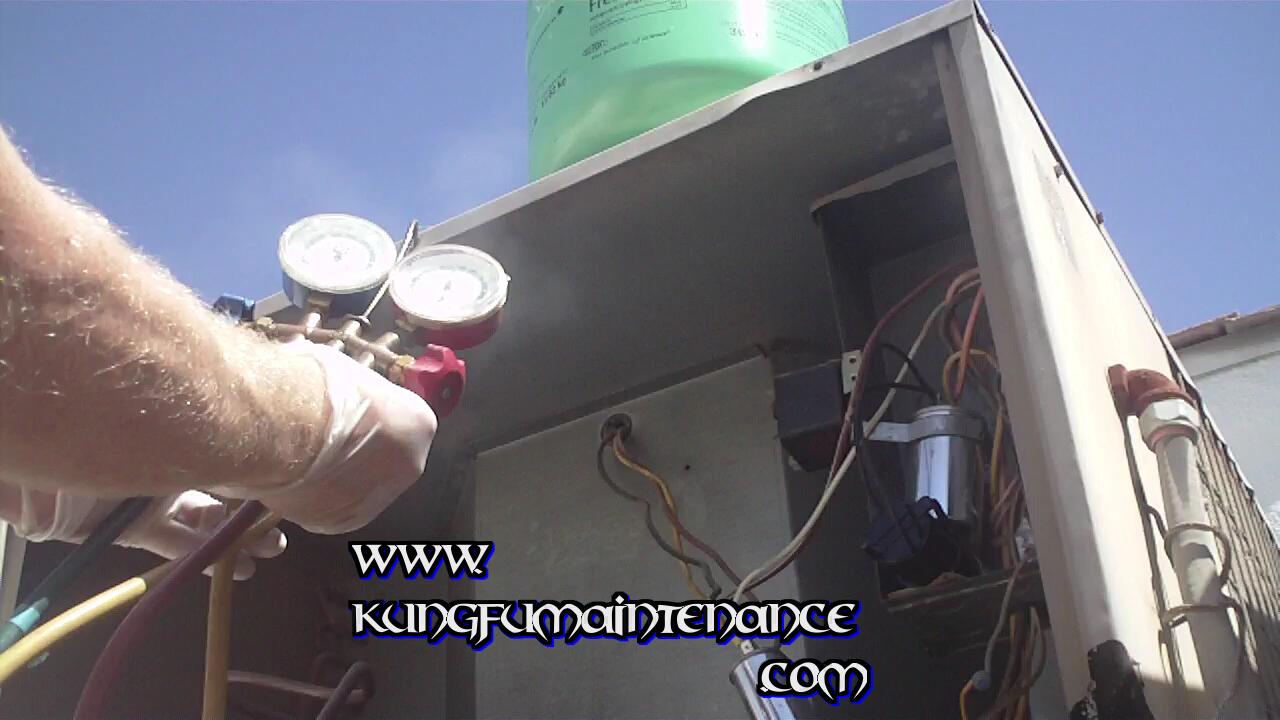
And than I will go ahead and hook up the middle yellow line to our refrigerant can. Up top here. And again got a quick connect up here. You don’t need a quick connect up here on the middle line as much because you can turn the refrigerant off here. But anyway I have one on there so. And were going to open our can of refrigerant here. and this is R-22.
Ok. Here we go and than purge our line here. So I am just going to crack it. Let a little bit of refrigerant out. And now we are ready to charge it. So I am just going to open it for a second and than go down and turn the unit on so we can charge it. Yeah it feels like it is low so.
Ok I am going to run downstairs. Be right back.
Ok. So were on now. Everything is running good. The fan motor is running.
The compressor has kicked on. And you can see this is showing like only ten pounds of pressure. Not too good.
Definitely low on freon so. Oh yeah. Sounds thirsty. So I was working in this unit yesterday and noticed the air conditioner wasn’t cooling so I knew I needed to get up here today.
Get up here early before it gets hot.
Here is the accumulator and it is starting to get cold It is cold about half way up. Anyway I am just going to be doing this one by feel Because like I said my gauges are kind of on their last leg. Time to replace them.
See how loose that is I mean this could be tightend up but also the needles are kind of bent and the caps are starting to fall off so time for some new gauges but these are a cappilary tube system and the nice thing about a capillary tube system is it is a lot more forgiving than other systems. It can actually, you would have to actually really kind of try to overcharge these.
Anyway once it is nice and cold here on both sides of the accumulator than I know that it is going to be good. So I am just going to Wait until this flashes nice and ice cold. And like I said if I put a little bit of extra refrigerant in
it is going to be okay because it just holds it in the pot. And the way the capillary tube system works is, it is a fixed orifice so it only allows so much refrigerant through at a time. you know if you’re a little bit overcharge it is not like it lets more refrigerant through. It just stores it here and lets it go through. As long as you are only charging
with vapor. you don’t want to flip your can over and charge it with liquid because than the liquid might
stay in the lines and can actually cause liquid slugging of the compressor
You can probably hear the refrigerant going into the system You can hear the change now as the pressures are starting to get balanced and get more closer to where they should. You can hear the sound difference less and less
refrigerant is being suctioned in as it starts to climb.
We definitely have a leak somewhere. Possibly here at the schrader valve.
Which is where you usually get your leaks. You can kind of see some signs of moisture or oil right there. I am kind of guessing it is from the schrader valve. I will pop it off and take a peak inside the high side.
You can hear the pressure difference now of the refrigerant going in is a lot less than when we first did this. And it doesn’t seem to be leaking from the schrader valve so I will go ahead and tighten that back on.
What I have is a leak repair additive that I can add to the system because this one it has been good the whole summer. It hasn’t gone low on refrigerant or anything so it has just got a tiny micro leak in it somewhere. Those additives are kind of good for that as long as there is no moisture in the system. Ok and feeling my line it is still not cold. It is kind of warm. And we can check what our pressure is at here.
I’ll try to get the camera to focus a little bit. There we go. We will go ahead and turn the hand valve off. See where were at. Were at about about 40 pounds pressure there and on the green dial were only at fifteen so
we got a ways to go.
You can probably hear it I am going to turn it back on. I hear a lot of people don’t like these Janitrolls to much, but they are pretty easy to work on. Pretty simple. Maybe I’ve just gotten used to them. Been out here for a while so.
If you are using the high side you can get more of an accurate
reading of what your refrigerant levels are at.
Anyway when you work with refrigerant long enough you
probably will reach some day where your gauges really are not working properly and you are going to need to be able to charge the unit by feel
or by temperature and the other way we can check this is
check for the fifteen to twenty degree split inside the unit at an incoming and an outgoing register.
I have a video on that if you want to see that I can put the link on this video.
Its starting to get there. It is starting to feel a little colder down here. Allright.
Up on the roof top in Palm Springs here. Give you a little view around. Look around. While this thing charges up here. Pretty nice up on the palm trees here.
My palm trees are due for some trimming. Got a lot of dates on them.
Pretty good dates to. I have snacked on a few.
If you look around you can see the mountains over there.
Its a nice cooler day. It has actually cooled off out here now.
This Summer was a little bit milder. I think the hottest it got was about one nineteen, something like that. I remember a few days where it was a hundred and sixteen. Those were pretty warm.
But I have had other summers where it has hit as high as a hundred twenty seven degrees and so this Summer was pretty mild.
I got away easy.
I went through and well we preventative maintenanced the heck out of our air conditioning units to make it a better summer so. We had a much better summer.
This can take some time. There is a couple ways to speed the charge.
With the compressor being low on freon the freon helps cool
the compressor and with the compressor being low on freon the compressor starts to get pretty warm.
If you have an ice pack you can put that on top here and that can speed the charge. Or some really cold water so I have got some really cold water. And I am just going to pour it on here. Avoiding the electrical contacts obviously. And that helps speed the charge a little bit. Its starting to get there.
Ok, once I am all finished I will have to follow this up with that leak additive. To seal of any leaks here.
See this line down at the bottom of the compressorkind of funny
it is actually a heater. It heats up the bottom of the compressor.
And that helps it when it first starts to be in kind of the right condition for starting the compressor.
Right here is a filter drier. You can see the arrow
pointing this way. On a heat pump the arrow will point both ways because a heat pump has a reversing valve where it changes the direction
where as here the condenser is removing heat from the unit.
and at the evaporator it absorbs heat. On a heat pump it can switch to where you know the evaporator was absorbing heat and the condenser giving off the heat on a heat pump it can switch back to where now the condenser becomes the evaporator And the evaporator becomes the condensor. They switch roles. So you can heat your unit with a heat pump or you can cool your unit.
Heat pumps are a lot more sensitive about the charge. Your charge needs to be a lot more accurate where as like I was telling you these units have capillary tubes so they are a lot more forgiving.
It’s getting there. Drink a little water myself. Give you another shot of Palm Springs here. The mountains there.
There’s a tram that goes all the way to the top of the mountain up there. I guess there is like a cafe stuff like that. I’ve been out here like eight years
I still haven’t been up there. Some day maybe.
Or not.
A bird is snacking on some dates there. Happy campers. Alright see how we’re doing here. It’s getting there. It just takes a little time.
This unit seems to be in pretty good condition for being twenty six years old. Still kicking. Still kicking out the cool air. Getting there.
This is an accumulator it helps prevent liquid refrigerant from getting to the compressor and slugging the pistons. A lot of units these days don’t have these on them. Some of the heat pumps have them inside the unit.
These ones have been done outside.
It seems they went to some extra steps to preserve these units. This one doesn’t have it but on some of these other ones they have got a like another safety device this one has been taken out like on the high side it’s got a little piston in it as a protective shut off.
See if one of the other units has it. I will show it to you here. This one no.
bring you over here as this takes a little time. Wow all these units are gone.
Looks like they took them out on this whole roof. Maybe I am not going to get to show you.
Here is one. See right here this deal. Not exactly sure what you call this exactly. Maybe somebody else can tell me.
And exactly how it works i’m not sure either. I think it has just like a
piston that cuts off the flow if something’s wrong. If there is something wrong in the system. Something a little bit more for me to learn about.
There is always more.
Anyway go back to our unit over there. You can see these service mats.
You always want to do your refrigerant work, your air condition work, on the mats. Especially if you are changing a fan motor or putting in a new unit. You don’t want to put any chunks in the built up roof material.
Anyway it is getting colder. Were not there yet.
Disconnect box is over there.
Kind of funny story I heard of some places where the disconnect
they had people stealing all the units. They were stealing air conditioning units.
Some rougher areas have to do some drastic methods but anyway.
I heard about where they, what they did was they bypassed the disconnnect so that if you wanted to turn off power to work on the unit you would have to go into the unit itself and turn off the breaker.
It is sort of like an electric fence I was thinking about it is kinda like having an electric fence. A deterrent for people stealing units, stealing refrigerant, and stealing the entire units.
By having the power where you can’t disconnect it they were less likely to take those and they were stealing the disconnects and all that kind of stuff too so there is some rougher areas out there that call for some drastic measures.
No not the norm, but in those situations people have to get creative.
Have to do something different if there is a rough area.
Alright it is getting nice and chilly now. Still got a little ways. Might put a little more water on the compressor here. Try and speed this up.
I can feel it flash a lot, you know, after I put the water on and than I feel it right here. At the unit it just seems like all of a sudden it draws a lot
more refrigerant in.
It’s starting to flash nice and cold now. We are almost there.
Now I don’t know if you can see it so much in the camera but you can start to see a little bit of sweat on the line as this gets colder. Not completely there yet but we’re real close.
This is the little high side line to the compressor. You want to avoid
touching that especially on that end. I mean back here this part of it it is not so hot. But right there it is really hot. I have burned my arm lots of times by accident. Touch that aghhh tshhh.
Looks like not the best soldering job down there but definitely not the worst I’ve seen. This kind of looks like a newer compressor to. Like this isn’t the original compressor. I’m just guessing. Like it was replaced at some point.
Augh yeah we’re getting nice and chilly. Chilly, Chilli.
The final test again is going to be checking for the fifteen to twenty degree split inside. But it’s gonna happen. I have done enough of these to know
the way it is. Were good now. Nice and chilly.
Can’t trust my gauges. They are just too old. I gotta get some new gauge heads. See how it is showing twenty five on the green dial. Fifty on the pressure.
Nice and cool today. Man, what a difference it makes. I think it is supposed to be like a high of 81 today, 85, I am not too sure, but it is nice now. Probably about seventy six degrees outside. If feels good. Nice day.
Ok, we are there now. Nice and chilly. So I am going to go ahead and turn off the line here. And than disconnect the line. Listen for any leaks there. And everything is Ok.
And than make sure we put our schrader valve cap back on.
So there we go. We’re good there. Come up here,
and turn our refrigerant can off.
Disconnect our hoses. Than we have to release the refrigerant
from the line. We don’t want to leave it stored in there. Unless I was going to go and charge another unit right away which I am not.
So I am just going to go ahead and release it. There we go, and now its out. That one too. The middle one also.
Really the more accurate method is to hook up the high side but anyway.
We are good here. Alright.
Subscribe so you can get some of the be the first to get some of the new videos when I put new videos up.
I will try to make some more good videos for you. I’ll see you out there.
Ok so here it is inside the unit. It has already dropped to
seventy five I think that it started around seventy eight seventy nine.
Something like that.
And the air feels nice and cool coming out of the vent. Lets go back here to
where the evaporator is. The air handler right here. And just like on the roof, the low side should be nice and chilly all the way to right here.
And it is. Nice and chilly.
You can see it. You can kind of see it starting to sweat. You can see on my finger. For a second how it’s like moisture.
So that is why we have got the insulation here.
So oh it’s nice and chilly.Perfect see it there the moisture on my finger. There we go. We got our condensate drain. The drain vent
Right here alright.
~~~~~~~~~~~~~~~ Danger High Voltage!~~~~~~~~~~~~~~~~~~~~~~
~~~~You must be EPA certified to perform these repairs.~~~~~~~~~
~~~~~~~~~~~~Always wear gloves when handling~~~~~~~~~~~~~~~
~~~~~~~~~~~~~refrigerants to prevent frostbite.~~~~~~~~~~~~~~~~
~~~~~~~~~~~~Always use quick connect fittings.~~~~~~~~~~~~~~~~
High and Low Side Quick Connected
If you have an air conditioner that is not cooling, first prove that the compressor is running. Touch the low (also called the liquid or suction) side line coming from the compressor. If it is not cold to the touch, this is a sign that the A.C. unit is low on refrigerant.
To charge the A.C. system, first calibrate your gauges. (To be safer you can pull the disconnect, and discharge the capacitor before setting up gauges. To check the unit pressures and add refrigerant you will need to turn the unit back on.) Prove that the hand valves are turned off. Next remove the suction line schrader valve cap for the low side and hook up your blue cool side line to the port with your quick connect. Next crack the blue side service valve below your dials to purge any air from the line. This is called a “deminimus release” it uses the refrigerant to force the air from the line purging the air containing moisture from the hoses. Air contains moisture and if it let into the unit will mix with the refrigerant gas and turn into acid causing leaks and reaking havoc on the system.
Cracking the Low Side Service Valve
Repeat the same process for the high side. Attach the red gas side line to the high side port and purge the air from the line by cracking the line at the service valve again using a tiny bit of the refrigerant to force the air out of the hose.
Next hook up the yellow service valve hose to your refrigerant bottle with the service line quick connect. Keep the can valve side up for vapor charging (except for very specialized applications) thereby avoiding putting liquid in the plumbing to prevent liquid slugging of the compressor pistons and premature compressor failure that would be like an air conditioner heart attack. Open the refrigerant can valve and purge the service hose by cracking the yellow line service valve for a quick second.
Deminimus Release
Your gauges (If in good working order and calibrated) will now give you a good show of what is in the system. The outer rings on the gauges show PSI( pounds per square inch) and the inner colored dials show the pressures for accordingly colored types of refrigerants. (Each type of gas has a different temperature pressure relationship but I will save getting into that for another time.) For example, green is for r22(Right now, arguably the most widely used freon (Soon to be phased out according to the Montreal Protocol, (check my blogs on Isceon).
Now you are ready to charge the unit. Open the blue side service handle and you will hear the refrigerant being sucked into the system. I f you are charging R-22 what you wan’t is ambient temperature plus thirty degrees on the high side. If the temperature is eighty five degrees outside then you will be looking for one hundred fifteen on the green r22 high side dial. Each system is a little different so this is only a very basic example.
One method of proving good pressures is measuring the temperature at the evaporator coil. The ideal temperature for the evaporator for most freons is forty degrees. Another method is to check the temperatures with thermometers for a fifteen to twenty degree split between the air going into the intake vent and the air coming out of a distribution register.
Each set up is a bit different. This is only a very basic example, with a few apps for measuring good refrigerant charge, not so much rules. You must digest the information in relation to the specifics of your particular components, area practices, and manufacturer recomendations.
The Year is A.C. 101 ~ Welcome to Kung Fu Maintenance Land.
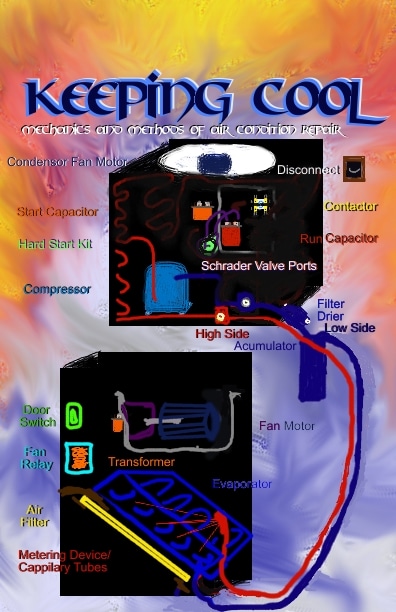
Welcome to my Kung Fu Maintenance A.C. 101 video interactive. You can watch a video discourse on each component of the air conditioner system by clicking on the part or part title in this interactive video menu.
Some of the videos for parts I am still developing and editing. I will add them to the mix as they are completed. Hope you like it. Please do mention it to some friends.
These videos discuss each parts role in the air conditioner system. The thermostat, disconnect, time delay fuses, breaker, contactor, run capacitor, start capacitor, fan motors, compressor, hard start kit, compressor protector (time delay, delay on break, delay on make), filter driers, accumulator, refrigerants, wiring, terminal leads, wire connectors, door switch, fan relay, blower wheel, evaporator coil, restrictive devices (capillary tubes, thx valves etc…), condensor, schrader valves, ports, critical seals, shut offs, thermal switches, directional switches, start, common, run, leads, compressor, hermetic, fans, baffles, gauges, high side (gas, pressure,), low side(liquid, suction), tubing, ACR copper, air handlers, relays, solenoids, air filters, condensate drains, condensate pans, gravel wells, french drains, all working together to take the heat off of you and bring you cold air.
I hope these videos treat you well like a cool glass of lemonade on a blistering hot day. A bit of rejuvenation. So far all of these videos were made on over one hundred degree days. They can’t all be easy, but I’ll settle for a few. I am happy to pass on and share my experiences with you so that your experiences can be a bit easier through understanding. I am out to save you time, money, energy, headache, and backache.
~I hope to hear about or see you gaining some nice ground~
A Strategy for Refrigerant Conversion From R-22 to R438A
If you are in the maintenance or HVAC business you have probably heard by now about the R-22 phase out under the Montreal Protocol. Perhaps you even read my previous article on the subject (Retrofitting Reasons to use Dupont™ ISCEON® MO99™ instead of R410A). If you haven’t read it yetI recommend you read it before, or after, as it will give you a better understanding of the factors.
R-22 is being phased out by 2020 due to its ozone damaging ways. There was a short time that production of condensers that use R-22 had stopped. Now companies are manufacturing condensers that can use R-22 again. They used to sell them as pre-charged units with R-22. Now manufacturers have found that they can only sell them as dry units. Dry units need to be charged with refrigerant at the time of install.
Isceon M099 is a relatively new refrigerant brought on the scene by Dupont. There are some very nice qualities to this refrigerant a.k.a. R438A. It has very similar operating characteristics to R-22 without the ozone abuse. At the time of this writing you can get a twenty five pound can of Isceon for just a few dollars over two hundred dollars and a thirty pound can of R-22 for about one eighty ( expect these prices to change quite quickly, R-22 will most likely climb in price as its dooms day approaches. Isceon will most likely stay the same, or it may go down, or up, a bit as it gains popularity). Isceon has a pressure temperature relationship very close to R-22 so the majority of HVAC techs will have an easy time switching over. Oil does not need to be changed, system does not need to be flushed, (unless a compressor burned out), wiring generally does not need to be changed (always check manufacturer specs), evaporator coils do not need to be replaced. The one thing that does need to happen is the seals need to be replaced because the seals that were used with R-22 will shrink when charged with R438A (Isceon M099). This leads right into my plan of attack.
When you need to replace a condenser, this is the time to change over to Isceon. The new dry unit will have all new seals. If a system needs to be opened up for any reason, evaporator coil replacement, filter dryer replacement, etc…. or if a system has lost its charge due to a leak, these are all good times to retrofit to Isceon. Recover R-22 and use it to maintain your other R-22 units (after acid testing it and verifying it is ok to use). Make sure all Schrader valves, or other seals are replaced, a new filter drier is installed (anytime the system is opened), the system is leak tested with nitrogen, and vacuumed down to 250 microns (29.91 Hg) for a good amount of time to boil off any moisture. Now the system is ready to be charged with Isceon. The nice thing about Isceon is it has a cooler discharge temperature at the heart of the A/C (easier on the compressor).
Make sure to very clearly label the new units. Make it clear that they are charged with Isceon.R438A comes in a blue can so it would be good practice to color code the new units with a blue label that matches the refrigerant. Refrigerants should never be mixed or topped off with a different type. If you have several buildings in a complex and the condensers are nearing the end of their lifespan it may be smart to retrofit one building or so, year by year as a capital improvement. You can reuse good fan motors, blades, baffles, lids and such from the phased out units to better offset the costs and help make it easier to keep your remaining units working. This way you can phase into Isceon (R438A) before R-22 is phased out.
While R410A air conditioning puts out more cooling BTU’s it often uses more electrical energy in the short and/or long run.
R410A equipment often has a higher amp draw requiring wiring upgrades, larger breakers, larger wires, larger electrical whips, and fuses etc…
Often evaporator coils and line sets need to be replaced to accommodate the higher pressures that R410a uses.
ISCEON® MO99™ (alternatively called R-438A) retrofit has far less of an environmental impact.
R-22 system does not need to be flushed when retro fitting to ISCEON MO99. For R-410A retrofit, system must be flushed and oil changed.
For ISCEON MO99 retrofit, oil does not need to be replaced. R-410A uses a different oil type (poe (polyester) oil) that will not mix right with R-22’s oil type (mineral oil) and so oil must be changed.
ISCEON MO99 can be used with existing R-22 condensors and evaporators as long as Schrader valves and or seals are replaced. (ISCEON MO99 refrigerant causes seals that have been using R-22 to shrink.) R-410A uses higher pressures and should not be used with R-22 compressors so whole condensers are usually replaced, seals and all.
ISCEON M099 has a lower operating temperature at the compressor and is slightly easier on the compressor the heart of the air condition system.
Both R410A and ISCEON MO99 are not going to be phased out thru the Montreal Protocol like R-22 in 2020.
ISCEON M099 does not damage the ozone layer. (At least not like cows do! Or R-22)
Of course all of this is debatable and that should be interesting so let’s get at it. If you have some ideas why you think R-410A (or another refrigerant) is the way to go I would love to hear them. Alternatively, if you have any more points about the benefits of ISCEON MO99 (R438A) that would be cool. Share your experiences here on The KFM Blog as a response. If I think they are worthy I will post them as long as things are kept clean. Fair Enough?
This is my eleventh video. It was the first Kung Fu Maintenance video I used my voice on. To my surprise it has gotten far more hits than any of my others. This is true even though (among my vids) it is one of the most disliked uploaded videos. Perhaps for the noise (voice) (music) but I think more than anything for the fact that this repair takes so much patience. It is a tried and true method and I have done it many times. It is not my favorite repair either but it normally works, unless the fan is beyond balancing. I have had many dislikes over the brand of this particular fan. Also I think it gets many dislikes because there are some who think it is not worth it to balance a fan (or believe it impossible) and would rather buy a new one. This is fine. (You can make pizza, if you have the dough( and sauce, and cheese etc. . ). What follows is for the savers.
First clean the fan. Then tighten up all the screws. Tighten the fan blade screws and especially the down rod set screws where the down rod goes into the fan top. Often times this is enough to fix the wobble. Sometimes you can adjust the position of the light kit or the position of the down rod socket by pushing the whole fan up and turning a little bit (with power off of course). Try several different positions to see if you can rid the wobble.
If those attempts don’t rid your wobble than you will need a fan balancing kit. They are sold at most hardware stores or you can order one from my store Kung Fu Maintenance Supply and Appliance. They usually have instructions to follow which normally involve the following.
Clip the fan blade weight clip to the back edge of a fan blade either on the very end center or in the middle at the back of the blade. Turn the fan on and note if it wobbles more or less. Note the blade you started with than do the same on each of the other fan blades to determine which one gives you the least amount of wobble. This takes a lot of patience as you have to let the fan blades stop each time so no one gets hurt.
Next clip the fan weight in the center at the back of the fan blade with the least wobble. Slide the clip two inches toward the fan center and check the wobble. Than slide the clip four inch away from the center of the fan blade. Whichever direction towards the center or further away gives you the least wobble continue checking for the least wobble in two inch increments until you determine the best spot for least wobble. This is where you will stick one of the fan weights clean the spot on the center top of the fan blade really well. This way the weight doesn’t go flying off later (It’s all fun and games till someone gets hurt). Remove the plastic covering the adhesive and press it down top center of the fan blade directly in line with your fan weight clip.
Now you can remove the fan weight clip and check for wobbling. All set you’re all done but if there is still some wobble sometimes it takes more than one weight. This is why the weight kit usually comes with two or three weights. Repeat the entire process again with the second and if necessary the third weight. Yes it is understandable that this video gets some dislikes. I could even sometimes dislike it myself. It puts a real tester on ADD and caffeinated people .
First pull the A/C disconnect and discharge the capacitor. Next rinse the coils with a garden hose and hand sprayer (make sure the spray is not too strong to avoid bending the condenser fins) starting from the inside fins thru the lid, spray as much of the dirt to the outside. Avoid getting the fan condenser motor wet but do rinse off the blades as needed. Next clean off the outside of the fins with the spray spraying straight but angle downward. Avoid spraying sideways to prevent bending the fins. Next apply the coil cleaner with a garden sprayer or by following manufacturer’s recommendations. Wait manufacturers recommended time (usually about five minutes) and rinse the coils inside and out thoroughly.
Artwork diagram from the book Kung Fu Maintenance
Clean Evaporator Coils.
A no rinse evaporator coil cleaner is the easiest way to clean the evaporator coil. Spray it on the coils turn on the evaporator coil. Reset the panel door turn on the A/C and wait the manufacturers recommended time (usually between five and thirty minutes).
Replace Air Filters.
Replace filters every three months and every month if possible during higher use seasons. If you or a family member suffer from allergies use a HEPA filter. HEPA stands for high efficiency particle arrestor. The HEPA filter catches smaller particles so your noses and lungs don’t have to.
Clear Condensate Pans, Drains, and Lines.
Use a wet dry vacuum to vacuum out the pan and lines. On some systems you may need to hook up a smaller hose to the wet dry suction to get better access to the pan. You can make a quick rig for this with a small length of plastic hose and duct tape. Just insert two to three foot length of hose into wet dry vacuum suction hose end and duct tape in place wrapping the tape around the union covering all gaps (makeshift reducer coupling).
Add Condensate Tablets to Drain Pans.
Good condensate pan tablets contain rust and mold inhibitors. They also contain an anti-coagulant that keeps the dirt from clumping together and clogging your condensate drain. They will help preserve the life of your condensate drain pan as well as help keep the air you and your guests are breathing healthier and better smelling.
Tape all Areas of Air Leakage at Air Handler.
Apply HVAC foil tape or other HVAC rated tape to seal any open joints. Use an old dollar bill or a paper towel to locate any air leakage whether blowing out or sucking in. Hold the dollar bill or paper by one end and see if the other end is affected, either sucked towards or blown away from the air handler when you move it around the system. That is a one dollar or less air leak locator. Seal off any leakages with tape to improve the efficiency of the system.
Check for Fifteen to Twenty Degree Split.
Turn on the system and wait five to ten minutes for the pressures to equalize. Test the temperature going in the intake vent and then test the temperature coming out of one of the registers. If you have two thermometers, set one up at each, and take your readings. If your reading coming out of the register is fifteen to twenty degrees cooler then the air being sucked into the intake then your refrigerant charge is ok. If not then your system will need to be charged and the refrigerant leak located (most often at a Schrader valve, I cover this and many other factors in my book Kung Fu Maintenance). If you are not EPA certified you will need the services of a qualified HVAC technician.